
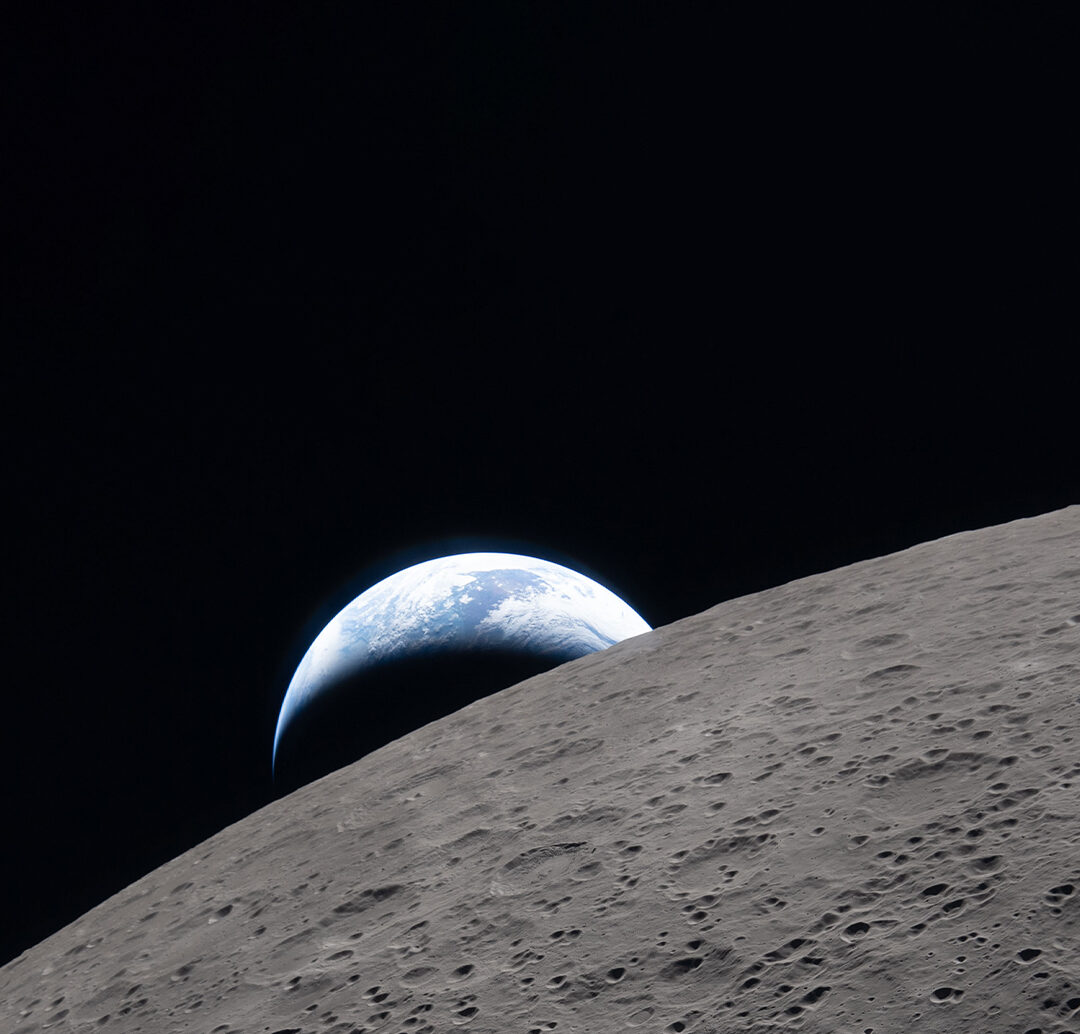
The successful completion of Artemis II should not be read merely as a scientific milestone or a geopolitical headline. When a crewed lunar mission is executed successfully, the outcome is not only technological validation, it is also a repricing of risk across the entire space economy. Artemis II, launched on April 1 and completed on April 10, 2026, was NASA’s first crewed lunar flyby in half a century and a critical systems-level test for long-duration human deep-space travel.
That distinction matters for investors. Capital does not move at scale into sectors that are still perceived as purely experimental. It moves when uncertainty begins to compress. Every successful mission reduces the perceived probability of catastrophic failure not only for a single spacecraft, but for the full industrial stack around it: propulsion, re-entry systems, avionics, software, communications, life-support architectures, radiation mitigation, orbital logistics, debris tracking, and lunar infrastructure. In financial terms, success in deep-space missions expands the investable surface area of the sector.
This is exactly why space exploration should be viewed less as a romantic project and more as civilizational capital expenditure. The global space economy reached $613 billion in 2024, with the commercial sector accounting for 78% of total activity, while Space Capital reported $55.3 billion of investment in 2025, a record year that reflected capital flowing increasingly toward companies solving hard, infrastructure-grade problems.
And yet, the technical difficulty remains very real. NASA continues to classify radiation as a major human-spaceflight risk, with exposure linked to higher long-term health risks. Orbital debris remains one of the most serious hazards to spacecraft and astronauts, with even very small particles capable of causing outsized damage at orbital speeds. Re-entry itself is still one of the most dangerous phases of any mission, which is precisely why Orion’s heat shield underwent extensive post-Artemis I investigation and testing after unexpected char loss was identified before Artemis II flew.
This is the key investment point: successful missions do not mean the problem has been solved. They mean the learning curve is becoming financeable. Engineering errors, material limits, thermal protection issues, debris exposure, radiation shielding, autonomy, and deep-space communications are not arguments against investment. They are the reason investment is necessary. They define the startups that will matter. One company will solve thermal protection. Another will improve navigation and autonomy. Another will address debris intelligence. Another will build in-space manufacturing, robotics, or lunar communications. Space becomes scalable when each mission creates enough confidence for capital to fund the next layer of specialization.
The scientific rationale is even larger than the investment case. Human beings often discount space exploration because the largest existential astronomical threats appear too distant to matter on human timescales. But astronomy teaches the opposite lesson: cosmic risk is real, even if its time horizon is long. NASA’s asteroid-monitoring systems exist precisely because impact risk is not fictional. The Sun will not remain stable forever. And the long-run evolution of our galactic environment is not static either. In the scale of a human life, these horizons feel abstract. In the scale of civilization, they are strategic.
So the deeper argument for investing in space is not escapism. It is continuity. Every serious economy claims that it invests for the next generation. Space exploration is simply the longest-duration version of that same principle. If we want humanity to remain adaptive, resilient, and expandable beyond a single planet, then successful missions like Artemis II matter because they make the future more fundable.
In that sense, deep-space exploration is not a luxury project. It is a gradual transition from survival by luck to survival by design.
The transition from homo-sapiens to Homo-Deus.